1.  Interior ministry tear gas purchase
2. Defense articles and defense services licensed for export under 22 U.S.C.   2778 of the Arms Export Control Act
3. Training Spending and US Military Goals

4. Press releases from US Department of Defense
5. Other links

1. Interior ministry tear gas purchase 

Interior Ministry Spokesman said on Saturday 23/2/2013 that the ministry ordered to import 140,000 US-sourced teargas canisters three months ago within its annual arming plan to protect State's vital facilities and private property.

Maj. Gen. Hani Abdul-Latif said that the cost of the deal reached 2.5 million dollars to protect these facilities. Link

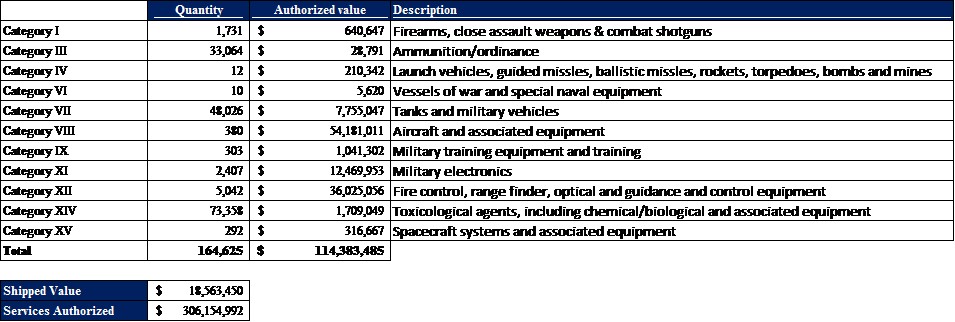
2. Defense articles and defense services licensed for export under 22 U.S.C. 2778 of the Arms Export Control Act (table listing Egypt requests and PDF with details on categories)

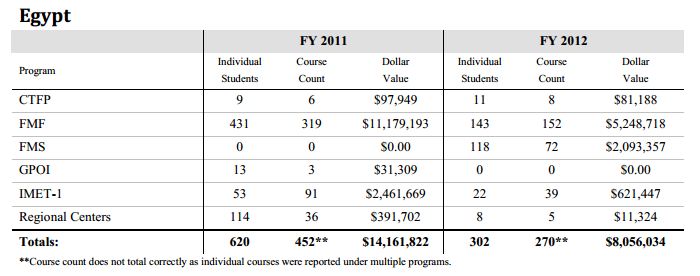
3. Training Spending and US Military Goals
  • Continue the vital U.S.-Egypt strategic relationship and ensure Egypt's continued commitment to peace with Israel 
  • Sustain and maintain U.S.-origin military equipment and systems to keep the Egyptian military modern and fully operational
  • Enhance interoperability of the Egyptian military to enable participation in coalition operations and exercises
  • Defeat terrorism through strengthened border security and tunnel detection capability
Search for Egypt in bottom two PDFs to get to the section (page 3 in the first PDF and page 4 in the second PDF)

Past years spending can be found here

4.  Press releases from US Department of Defense

Search this website with "Egypt" to scan through relevant press releases
  • Co-production of Abrams Tank (This has always been the big one for Egypt-US military spending, this document leads me to believe that almost all FMF goes to this specific endeavor given that we get around $1.3B annually and the size of this request)
  • Skyguard AMOUN Solid-State TransmittersThe Egyptian Navy intends to purchase this equipment to improve the reliability and maintainability of the Skyguard air defense system.  Egypt’s current transmitters are over 30 years old, obsolete, or nonfunctional.) 

Additionally, here are some "Excess Defense Spending" items granted to Egypt (last in 2009)

5. Other


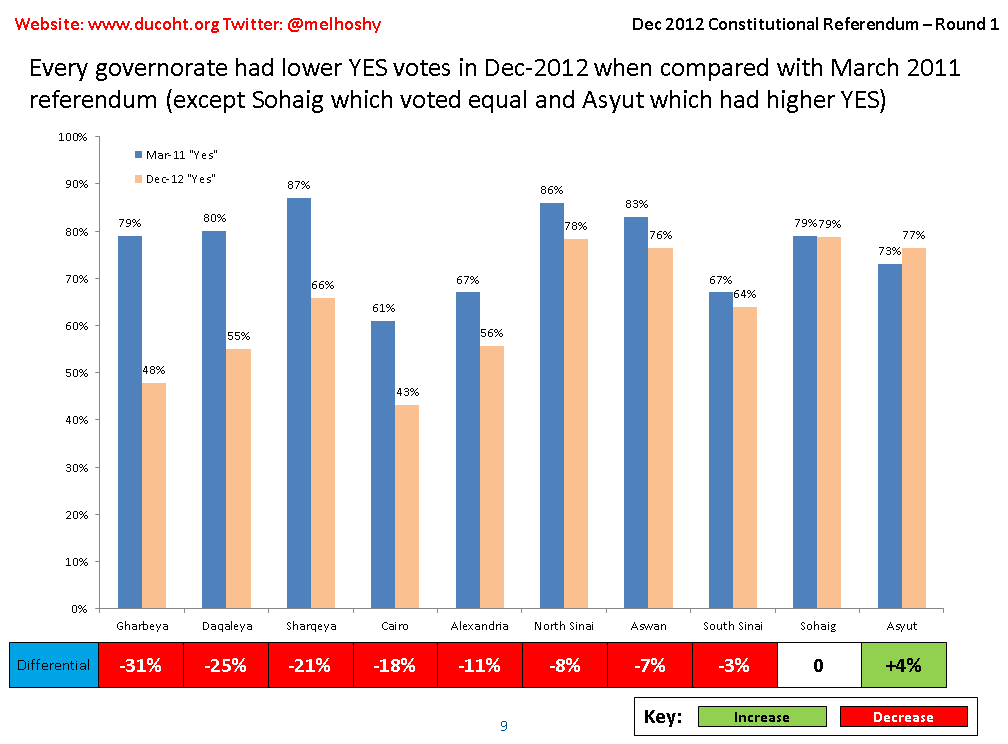
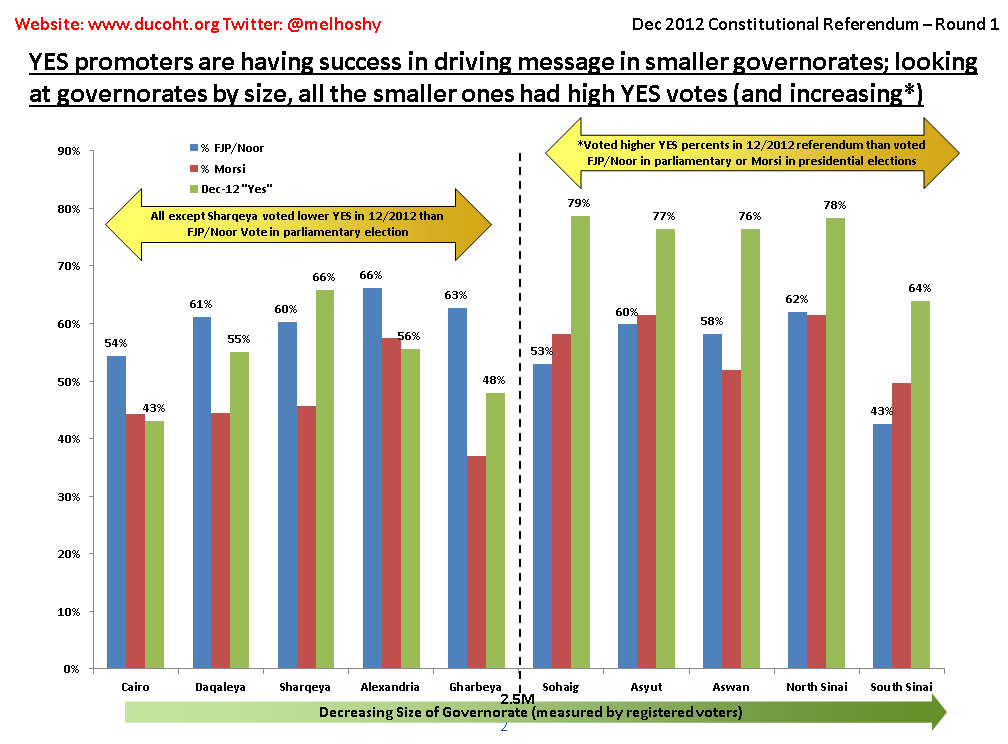
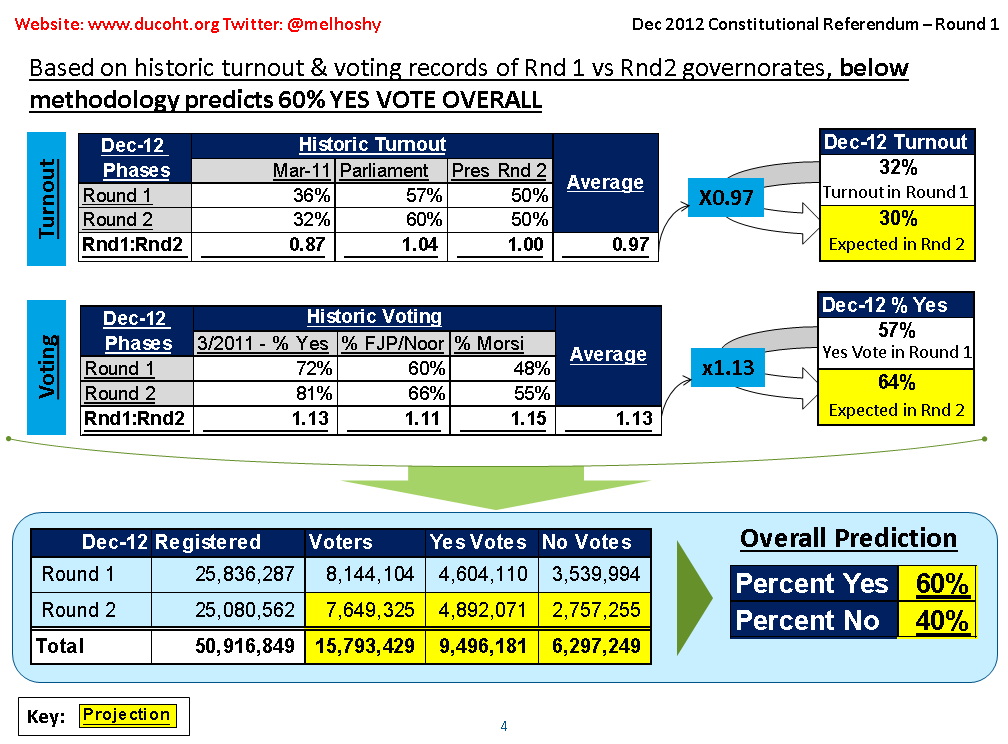
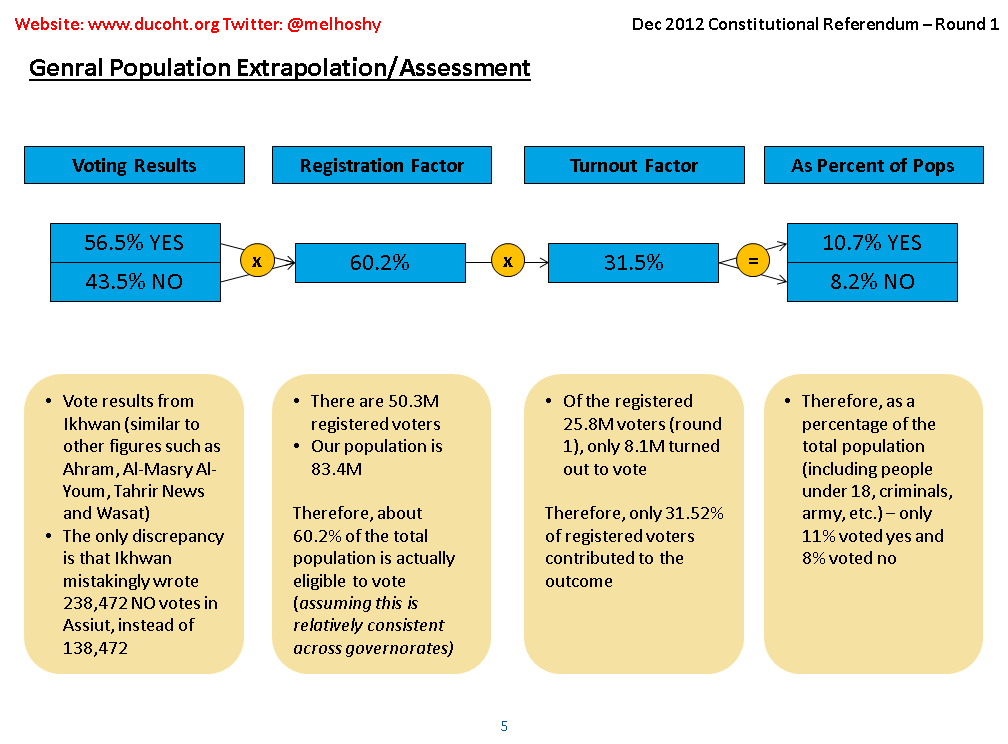
Updated on Monday (12/17) morning, below are 8 slides covering (click on any slide for larger version):

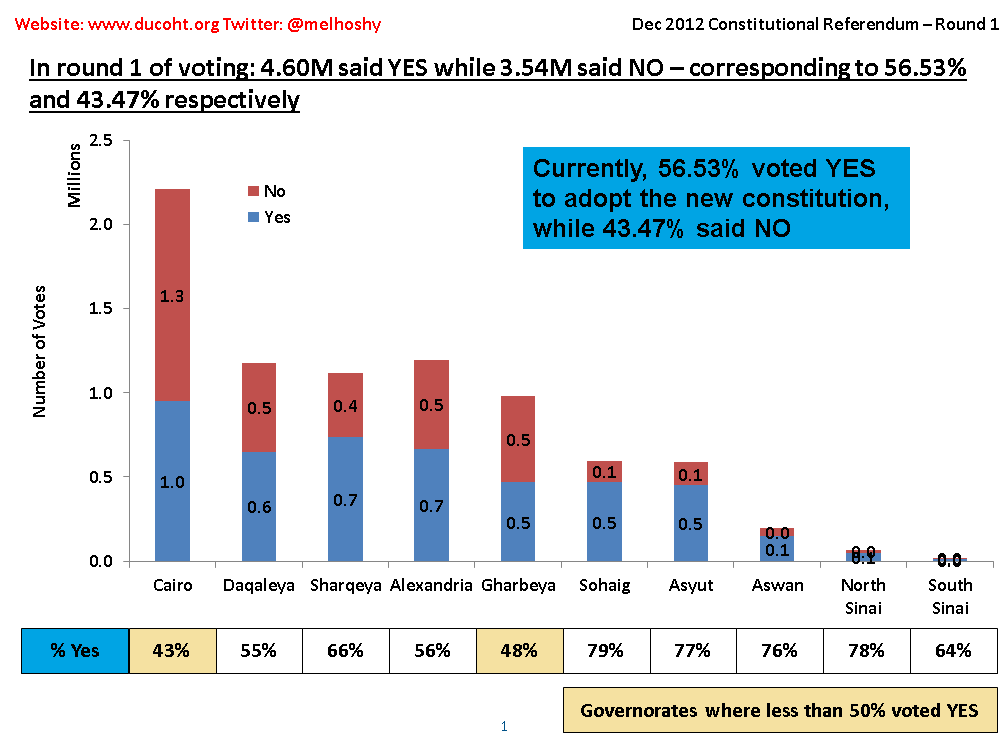
1. Voting results: 57% said YES in Round 1
2. Projections for Round 2: Expected 30% turnout with 64% YES vote - yielding overall result, across both rounds, at 60% YES
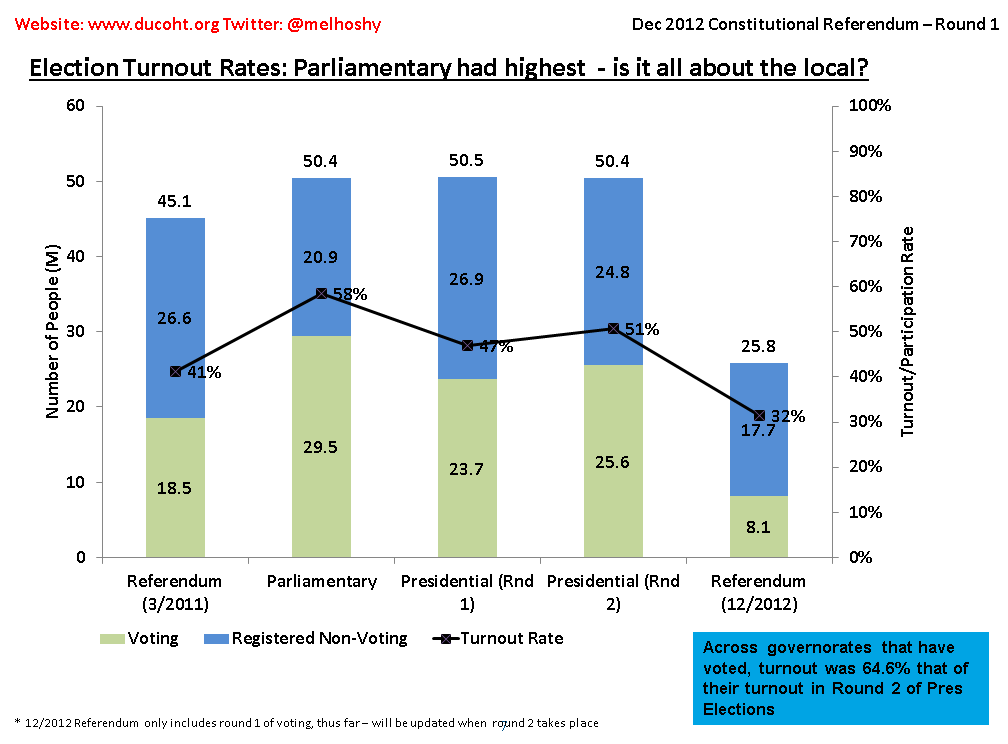
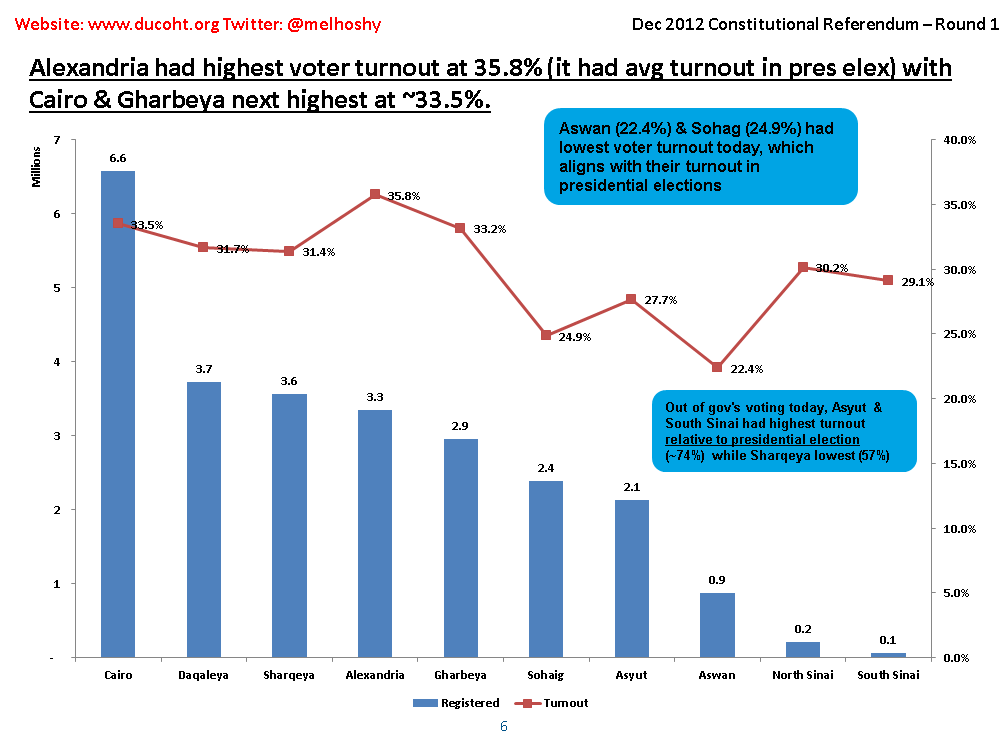
3. Participation Rates: 32% in Round 1 - pretty low
4. Detailed/underlying data (any corrections welcome)

1. Voting Results

The voting results are compiled from the Ikhwan website (given their accuracy in presidential elections, I will use their voting data for now).  The registered voters for this referendum comes from Egypt Independent.  All other data comes from previous analyses that can be found sourced elsewhere on the website.
2. Projections for Round 2 (and more detailed results)

The below is my humble attempt at just making projections based on historic data so it obviously does not isolate certain factors that may have existed during one election vs another - more importantly, it does not factor any effects that may have taken place since the presidential elections through today and/or any effects that on the ground campaigning may have over the coming week.

It really does not entail much more than taking data and extrapolating it so take it at face value but it is interesting in either of two cases:

1. If it is right: Then we are starting to see some voting trends across governorates and parties can begin to capitalize on this and target campaigns.  Or, I just got lucky and it was some other factors/data/variables.

2. If it is wrong: Then we see deviations in Egypt's voting across the elections and it illustrates changing tendencies and fluid loyalties.  Or, my methodology/analysis was flawed.

The biggest caveat of all the analysis on this website (thus far at least) is that it is based on governorates level data and results.  For example, in Cairo there are 43 marakiz which would allow for a much more granular analysis.


3. Participation Rates

4. Detailed/underling data
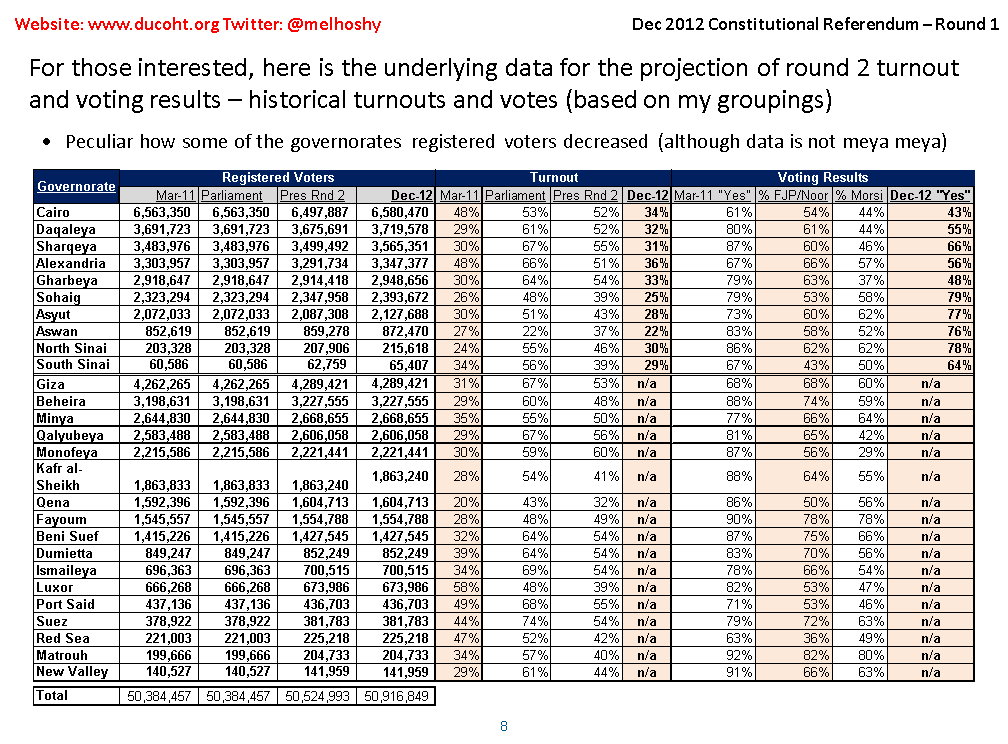
Slide 3: For governorates that have not yet voted, registered voter count is based on Rnd2 of presidential elections.  For governorates that have voted already, Ahram published an atricle which had their updated registerd voter count.

Slide 8: The March 2011 referendum registered voter count is based on the parliamentary election data I found on the elections.eg website. I have not been able to find registered voters for the Mar-11 referendum, and have been told there isn't one but please let me know if you have it.
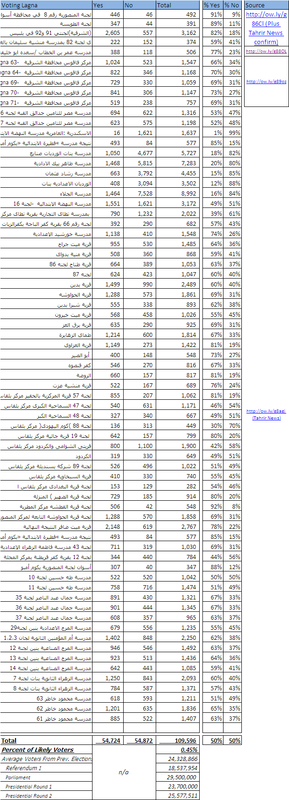
 
 
CURRENT STATUS: 110,000 votes counted with 50% YES and 50% NO - however, Alexandria plays largely in these figures! Removing ALEXANDRIA gives you 65% YES....

Attempting to compile all the referendum results as they come out and, with @weskandar's great idea to cross-tab those with reported violations and see if there is trends/correlations between %YES VOTE and reported violations. 

Below is a VERY preliminary tally of vote results, just setting up and will continue to add ligan as they come in but have already started building on the below.  (Additionally, here is a governorate level spreadsheet that will be filled out - likely faster than I can do mine)

Update 1 (11PM): Apparently, only 16,000 votes have been announced so far - so the below should be about 25% of publicized results 

Update 2 (11:30PM): Reports that 40,000 votes have been announced so far, with around 75% voting "YES"
 
 
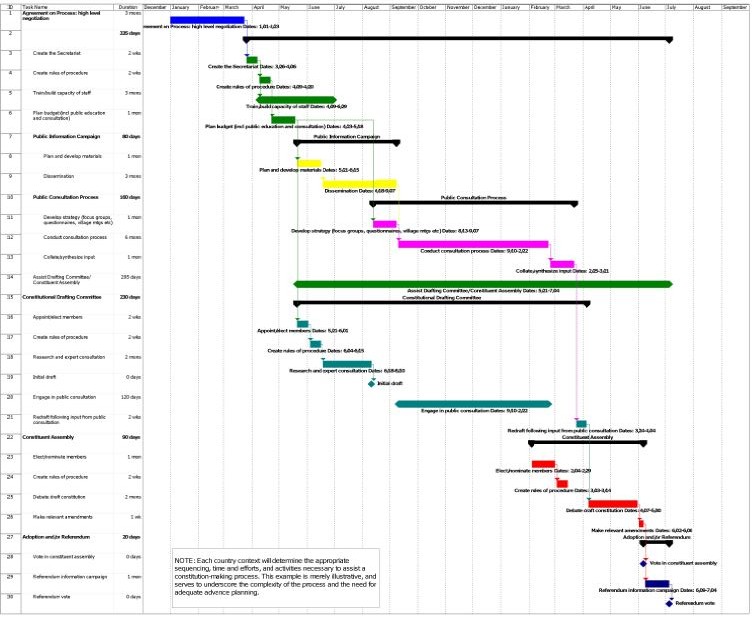
 "Example consitution-making process sequencing and timing" as recommended by Secretary General's office.  I am assuming we probably don't need every single step listed here but to be this far off is troubling... 

The full report outlines the principles that the UN has found beneficial through their experience, I don’t see us including many of them…

Additionally, below is a document "Constitution Building Processes and Democratization: A Discussion of Twelve Case Studies" - I think Rwanda is an interesting example.

Popular consultation certainly brought about public support for a Rwanda constitution, as it did in South Africa—another country with a highly participatory process. In contrast, the people have strongly rejected the constitutions in Nigeria and Bahrain, which were not at all participatory for the very reason that they were imposed on, rather than made by, the people.
The below paper as an extremely interesting assessment of case studies (including those above) and tries to identify some trends..
The cases reviewed in the IDEA study also emphasized that frequently the conflicts resulted from, or were exacerbated by, stark elite-population divisions. Thus, any chance of long-term resolution of such conflicts would require the sort of dialogue and negotiation that was rendered possible by the participatory national dialogue processes. (I think this is pretty applicable to Egypt, particularly with relation to the labor strikes – also, another paper I read stated that 
In the study, the more representative and more inclusive constitution building processes resulted in constitutions favoring free and fair elections, greater political equality, more social justice provisions, human rights protections, and stronger accountability mechanisms. In contrast, processes dominated by one interest or faction tended to result in constitutions favoring that interest or entrenching power in the hands of certain groups. Moreover, the more participatory processes initiated a dialogue and began a process of democratic education in societies that had not had political freedom or the chance to shape the governance of their state in the past. The participatory processes seem to have empowered the people. 

Encarnación has argued that the key difference between the two outcomes is the question of who participated in the bargaining cartel. In Venezuela, Colombia, and Brazil the pact-making was elite-driven and secretive with few powerful actors, including the outgoing regime, whereas in Spain the bargaining group included practically the whole “ideological spectrum.” Thus, negotiations that involve a small number of elite participants, seek to impose long-term power divisions, restrict the policy agenda, and limit government accountability to the broader population, should be avoided as they undermine the quality of the democracy created in the long-term. 
Look, I don’t know close to enough about law but almost every paper, assessment, article etc. etc. I have read ALL point to the fact that the constitution building process needs to involve the public, have multiple drafts, etc. etc. and that this is crucial to a successful outcome.

HOWEVER, to be fair and present the counter-argument, the following paper states, in summary, in certain circumstances, direct mass participation appears manipulable, and in poorly institutionalized environments mass participation can actually help contribute to a democratic breakdown" in which "“threat-based bargaining” occurs - where both sides attempted to mobilize portions of the masses in order to pressure the other side into a favorable deal
Finally, the evidence here helps qualify one of the more important normative recommendations from existing work: that constitution-making should be highly participatory. Participation in constitution-making is said to increase the legitimacy of the constitution-making process, improve the quality of the product, and to increase the civic virtue of citizens. Further, some scholars led by Thomas Franck have asserted that there is an emerging norm of customary international law that constitution-making be a very participatory process.  These scholarly views in favor of participation are closely linked to the dualist theory of democracy, which holds that constitution-making moments are qualitatively different from ordinary political moments.

Empirical evidence on these claims about the value of participation is mixed. There are cases where high degrees of public participation have been successfully integrated into constitution-making processes: South Africa is a well-known example. The fascinating process in Iceland, where the drafting council is making massive use of social media to get input into the process, may be another.  However, one large-n empirical study of post-conflict constitution-making found that levels of participation had no effect on post-constitution-making levels of violence in many regions of the world.  Further, Moehler’s detailed fieldwork in Uganda found that citizens who had participated in that country’s constitution-making process actually developed lower levels of trust in government than their fellow-citizens who had participated less.204 Rather than instilling a sense of civic virtue, participation disenchanted citizens by acquainting them with a dysfunctional political system.

Levels of participation in the examples studied for this paper were not highly correlated with the values attributed to participation. It is commonly noted in the literature that forms of participation such as referenda may have little effect on the process, because they may be too manipulable to control power.  But more hands-on forms of constitution-making like civil society participation may also do little to enhance either the quality or legitimacy of the constitutional product. In Venezuela, very high levels of participation by civil society had no real impact on the final product but rather tended to affect peripheral provisions that were unimportant to Chavez and which constituted mere window-dressing. High levels of civil society participation did not prevent the constitution from being used to impose a competitive authoritarian regime.

Bolivia offers a more important point: very high levels of participation, at least in a polarized political environment, may make constitution-making much more difficult and may thus threaten a breakdown of order.  Elster and others have noted that conducting deliberations in public may sometimes make agreement more difficult because representatives working under the conditions may stick to their principles and be unwilling to make hard political  compromises.208  what happened in Bolivia is more what Elster calls “threat-based bargaining”: both sides attempted to mobilize portions of the masses in order to pressure the other side into a favorable deal.209 The trouble is that this is a dangerous game, in two senses. First, as Elster notes the masses on each side, once mobilized and ideologically charged, may narrow the range of possible agreement, perhaps even causing it to disappear entirely.

Bolivian delegates were unwilling to make deals that they otherwise would have cut for fear of angering their mass supporters. Second, the mobilized masses might start agitating for their own purposes and not those of the political elites. In Bolivia, the assembly essentially broke down over an issue, the location of the capital city, which was pushed by the masses in Sucre rather than by any of the party elites. These conditions—highly mobilized and polarized mass supporters—may be fairly common during regime changes in the developing world. As noted below, in some respects Egypt may combine similarly high levels of participation with significant polarization.211 And constitutional moments combine sets of factors that may make mass participation particularly difficult to process: mass expectations are often unrealistically high, and there are no institutional frameworks capable of channeling the public’s demands.

None of this indicates that mass participation is a bad idea under all circumstances. But it may help qualify its utility: in certain circumstances, direct mass participation appears manipulable, and in poorly institutionalized environments mass participation can actually help contribute to a democratic breakdown.
 
 
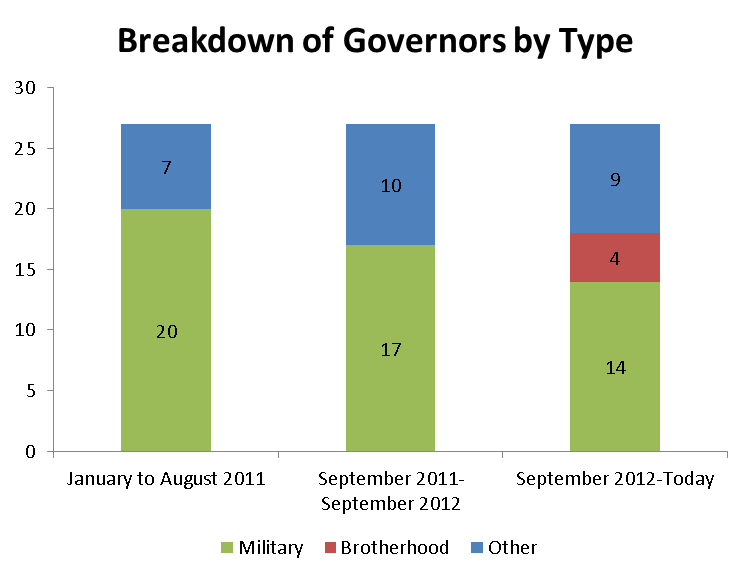
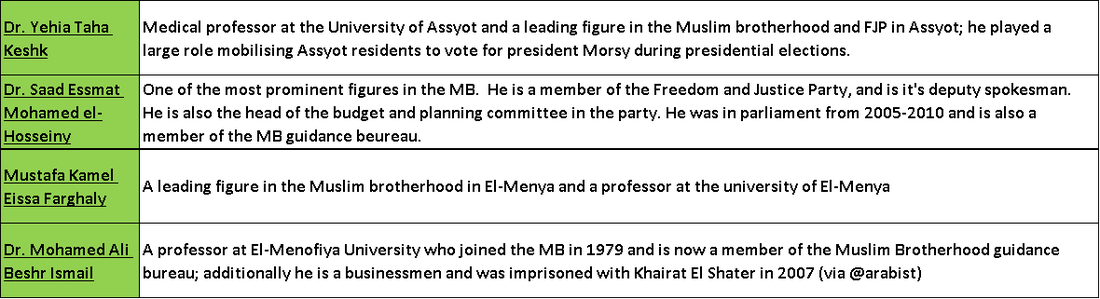
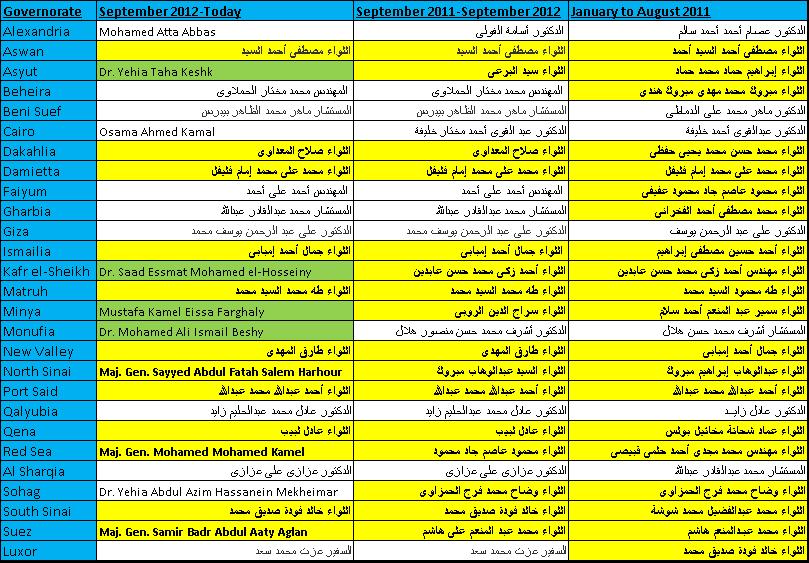
So we can see that the percentage of governors who were former military has decreased substantially since the uprising – from 20/27 position (75%) to 14/27 (52%).  However, it is interesting to note that 4 of the new appointments are clear MB sympathizers, with strong ties to the organization.

Additionally, Osama Kamal (who is the Engineers Syndicate undersecretary) won the election by running on the Brotherhood ticket - but he has not been classified as specifically MB based as he does not have direct ties/membership with the group.

The four new MB members are detailed in the below table:
Finally, a detailed list of all the governors color coded by type, can be found below:


Report 1: Brutality unpunished and unchecked: Egypt’s military kills and torture protesters with impunity highlights patterns of violations at three key demonstrations, and documents the brutal crackdown unleashed by the army during the 16-month rule by  the SCAF.
  
It focuses on:
  • The Maspero protests of October 2011, when 27 mainly Coptic Christian protesters were killed; 
  • Events outside the Cabinet Offices in  December 2011, when 17 protesters died; 
  • The Abbaseya sit-in in May 2012, when up to 12 people were killed.
Report 2: Agents of repression: Egypt’s police and the case for reform, outlines the total impunity enjoyed by the three main police forces in Egypt – the Central Security Forces (CSF), widely known as the riot police; the General Investigations Police, Egypt’s national police force; and the abolished State Security Investigation (SSI) service, highlighting the urgent need for sweeping reform of the police force. 

The report focuses on three key events:
  • Police violence during clashes with protesters at Mohamed Mahmoud Street near the Ministry of Interior in November 2011.
  • Police abuses during protests in the same street following the killings of Al-Ahly football club supporters in February 2012. 
  • Police violence during clashes in front of Nile City Towers, in Cairo, in August 2012.

Report 1: Brutality unpunished and unchecked: Egypt’s military kills and torture protesters with impunity 

Report 2: Agents of repression: Egypt’s police and the case for reform


So with all this presidential election business, in reality the past 24 hours or so seem to have been quite good for SCAF:
  1. SCAF appointed the president's chief staff including chief of staff (رئيسًا لديوان رئاسة الجمهورية) 
  2. They decided that the "'new president is a transitional one, for few months only'"
  3. Authorization of military to arrest civilians (emergency law back again yaani, they put it to good use pretty quick, see #7 in list below... was a good two weeks though guys!)
  4. Formation of National Defense Council with, as of yet, unstated duties

Plus via constitutional deceleration:
  1. Full legislative powers until new parliament elected
  2. Right to create a constituent assembly if elected one fails to complete its work,
  3. Head of SCAF acts as commander in chief
  4. Veto power on president's ability to declare war
  5. Full control of army budget, 
  6. Responsibility for appointment of commanders and extension of their tenure (i.e. they can give themselves contract extensions)
  7. If internal unrest occurs they have ability to veto presidential request to "maintain security and defend public properties"... Somewhat comically they go on to state that "current Egyptian law stipulates the powers of the armed forces and its authorities in cases where the military can use force, arrest or detain." (current in that they just allowed it for themselves a week ago)
  8. Ability to veto text within constitution that contradicts the "goals of the revolution and its basic principles" or "the principles mentioned in previous Egyptian constitutions" (nice side note to this also, keep in mind previous rulings of the HCC:  "Should the constituent assembly object to revising the contentious article, the article will be referred to the High Constitutional Court (HCC) which will then be obliged to give its verdict within seven days. The HCC's decision is final and will be published in the official gazette within three days from the date of issuance.")


Please let me know if I missed anything...

(If interested, all SCAF related blog posts can be found here and SCAF's dedicated page can be found here)

                           Wi Allaho Al Mowafaq Al Mosta3an 


The addition brings the current number of active SCAF members to TWENTY-THREE (23)

The addition is General Adel Morsy - actually a very important SCAF member as he is the " head of the judicial military authority". A full list of SCAF members - current and former - can be found at (http://www.ducoht.org/scaf.html  

Military Justice under SCAF: Overview and Links
  • In a September 5 news conference Gen. Adel Morsy of the ruling Supreme Council of the Armed Forces (SCAF) said that between January 28 and August 29, military tribunals tried 11,879 civilians. The tribunals convicted 8,071, including 1,836 suspended sentences; a further 1,225 convictions are awaiting ratification by the military.  (link)
  • Military courts have acquitted only 795 of the nearly 12,000 cases they have tried, a conviction rate of 93 percent, Human Rights Watch said. . (link)
  • Those sentenced included a 16-year-old child, Islam Harby Raga, currently in Tora prison serving a seven-year sentence after a military trial in February in which he was convicted on charges of assaulting a public official.  (link
  • According to a statement by General Adel Morsy, head of the military court, around November 2011 - 18 people have been sentenced to death so far.  (link)
  • On 1 April, the SCAF announced that it would permit the death penalty for convicted rapists if the victim was under 18. The law would apply to minors under 18 as well. Both Egyptian and international law prohibit the death penalty for minors.  (link)  
  • This was applied to a minor (under 18), along with three other individuals, for the rape of a 17-year old girl.  The minor was  Ahmed Marous Ibrahim, the other three individuals were: Tarek Ragheb, 33, Karim Dahrouj Ahmed el-Sawy, 28, and Mahmoud Ramadan Abdul Hussein, 21 (link
  • Around January 25, 2012 the military announced the release of 1,955 prisoners tried under military court. (link) However, they gave no indication to how many remained in prison through military court convictions.
Cases of children known to have faced investigation, prosecution, or sentencing before military courts (link)

Egypt’s military courts have investigated or tried at least 43 children over the past year, Human Rights Watch said in March 2012,including the pending trial of 16-year-old Ahmed Hamdy Abdel Aziz in connection with the Port Said football riots  
  1. Islam Harby, 15, arrested on March 23, 2011, and sentenced to seven years, currently detained in Tora maximum-security prison.
  2. Mohammed Ehab Sayyed Morsi, 17, arrested on March 9, 2011, and sentenced to 15 years, currently detained in Tora maximum-security prison. (Interview with his mother and detailed discussion of his case can be found here)
  3. Mohammed Abdul Hadi, 16, arrested on March 9, 2011, and sentenced to three years, released on May 21, 2011, after a two-month campaign along with the rest of the group of 122 protesters.
  4. Mustafa Gamal Edin, 15, arrested on March 9, 2011, sentenced to one year, released after three weeks detention. According to lawyers involved with his case, he was arrested along with 15 other children, whom military courts sentenced to one year in a social welfare institution. The decision was subsequently commuted and the group was released on April 8, 2011.
  5. Ahmed Hassan Mohamed, 17, arrested in March 2011, sentenced and released in January 2012.
  6. Nine children arrested on May 15, 2011, investigated by military prosecution, released after approximately one month, according to lawyers involved in the case.
  7. Mohamed Mahmoud El Khodary Sherif, 17, arrested on July 29, 2011, from Arish, held for 15 days in military investigative detention, then cleared of charges and released.
  8. Nine children arrested September 9-10, 2011, during protests outside the Israeli embassy, tried and sentenced by a military court to suspended sentences. They were released on November 1, 2011, according to lawyers handling their cases.
  9. Saif Sadek, a 15-year-old boy, arrested September 30, 2011, during a demonstration at the Ministry of Defense, acquitted and released on November 13, 2011.
  10. Three children arrested during Maspero demonstrations, on October 9, 2011, investigated by the military prosecutor and released on November 23, 2011, according to their lawyers.

A blog post documenting sourcing behind the other 22 member names can be found here

See full list of current and former SCAF members HERE (http://www.ducoht.org/scaf.html 


Maybe I am missing something, but I do not see how the election law can be considered unconstitutional when the constitution clearly stated that the law will determine the electoral system.  (and is remiscient of the judiciary's push - which was reinfoced today - to allow Shafiq to run, see here

The decision to dissolve parliament by the court was said to be because "the law governing the parliamentary elections was ruled unconstitutional by a lower court because it breached the principle of equality when it allowed party members to contest a third of seats set aside for independents." This was upheld by the Supreme Constitutional Court.
  1. However, Article 38 of the constitutional deceleration from March specially states: 

    ينظم القانون حق الترشيح لمجلسى الشعب والشورى وفقا لأى نظام انتخابى يحدده . ويجوز أن يتضمن حدا أدنى لمشاركة المرأة فى المجلسين (AR: http://ow.ly/bAcDC)

    "The law (according to ANY electoral provisions/system) determines the conditions that must be met for members of the People's Assembly and Shoura Councils - but it must ensure that females can run in both upper and lower house elections"
     

  2. Initially in September an electoral law was passed that reserved one-third of the seats in parliament to be elected as independents, with candidates affiliated with parties banned from contesting them.

  3. However, that was amended in October after SCAF agreed, in a document signed by the participating parties, to alter the law and allow members of political parties to run for the seats to be filled on a first-past-the-post basis.  The deceleration stated: 

    "Approval for amending the fifth article of the parliamentary elections law to match the views of the political forces to allow single-seat nominations for political parties candidates." (http://ow.ly/bAd8w)

The only stipulation of equality in the constitution was that women would be allowed to run (one could assume this extended to religions too).  How allowing certain people to run (i.e. not barring party candidates) is claimed as inequality is beyond me!  I would have understood more if the ruling was that the 2/3 of parliament seats that were designated for party candidates barred non-party candidates from running which could potentially be seen as inequality for non-party members.


The only possible explanation I can imagine is if they say that the only equal electoral law is to have the seats 50/50 split between party and individual based but they should have made that clear if that was the case and not waste all of our time and the state's money in running these elections - rather, ensuring that the law was amended at the time and "equal" elections were run.

The Supreme Constitutional Court is the highest judicial power in Egypt and, it alone undertakes the judicial control in respect of the constitutionality of the laws and regulations and shall undertake interpretation of legislative texts.  I cannot fathom how they interpreted this one.


Finally, Clause 30 in the constitution states:
"يؤدى الرئيس أمام مجلس الشعب قبل أن يباشر مهام منصبه اليمين"
"The president will take the following oath before the People's Assembly before assuming his position"

We will see how keen the judiciary is in upholding the constitution rather than abusing it for the benefit of the powers that be.   


UPDATE: Day Two "Exit Poll" Results

I will continue to post as the exit poll results come out then switch to another post to aggregate preliminary voting count results as apparently the FJP/MB organization 

1. Moussa Campaign from Twitter: Claims very close race between Morsi and Moussa (obvoiusly within the margin of error, although they don't have details on their figures to confirm that).  Moussa campaign is claiming that exit polls "are conducted by representatives in 13,000 polling stations in all governorates."

2. AlJazeera Arabic: Exit polls have a four way very close race (all of them within margin of error I would assume).  According to Jamal El Shayyal at AlJazeera the polling included 60,000 people...


Both figures are below... But again, keep in mind the exit polling industry is nascent (was somewhat of a trivial endeavor in Mubarak days) so take these results with skepticism...


So below are comparisons of three different “exit poll” (very loose use of the word!) results that I have come across this morning… See below for tables and details (click on images below the text for larger versions and links are provided to all original sources through highlighted red ink & aggregated pre-elections polls can be found here)

1.   Amr Moussa Campaign: Morsi, Moussa, Fotouh, Sabbahy, Shafiq
2.   Guy with Hala Sarhan on her show: 3 guys neck and neck, Moussa has no chance
3.   @Sandmonkey: Sabahi, Fotouh and Shafiq neck and neck then Morsi then Moussa
4.   “Rights & Citizenship Center” : Morsi & Fotouh tie, then Shafik, then Sabbahi & Moussa tie
5.   @FJPartyOrg : Corroborates Morsi lead but won't release results til after polls close


So numbers 1, 2, 4 and 5 all have Morsi in the lead or tied for it but other percentages vary. 

For Moussa Campaign polls Moussa comes in second place, while the other polls have him faring very poorly.  The "Rights and Citizenship Center" has Morsi and Aboul Fotouh tied with Shafik 

While I have never heard of them before, The "Rights and Citizenship Center" has some details of who leads in which governorates- will paste below as well. (Also, where they polled specifically)

Hala Sarhan guy (apparently from Al-Ahram center) doesn’t specifically state who is in the lead – just that Moussa is doing poorly, specifically “that Amr Moussa has no chance of winning” and that there are three people who are neck and neck in the race – Shafiq, Sabbahi and Aboul Fotouh.  

The above polling seems to corroborate with @Sandmonkey’s – as his article states :” Abol Futouh, Hamdeen & Shafik neck & neck at the top of the race. Then Morsi and fifth comes Amr Moussa.”  However, the pollster on the Hala Sarhan show did not explicitly mention that Morsi was doing poorly - just that three were neck and neck, while Moussa is doing poorly - so while not corroborating Sandmonkey's Moussa conclusion, it does not negate it per se.

Obviously the methodologies are not disclosed (guy in video mentions something about 3,000 phone calls but I believe that applies to the pre-election polling they were doing – unclear).

No official results will be announced until next week, and the early releases could be politically motivated (i.e. intended to influence the vote).

Moussa polls disclaimer: The percent of “others” was not stated in the first poll in the stayed the same as the second polling.

Participation rateshttp://www.egyptindependent.com/news/live-updates-candidates-cast-their-ballots

Abu Bakr al-Guindi, head of the Central Agency for Public Mobilization and Statistics (CAPMAS), estimated that the projected turnout of the presidential election will be roughly 60%, based on voter behavior on Wednesday.

Guy in Hala Sarhan video claims that participation rates was 12% of registered voters for the first day.


Egypt President Election Polls
From "Rights and Citizenship Center" polls


Rights and Citizenship Center Details
النحو التالي :

... محافظة القاهرة :
مدرسة رفاعة الطهطاوي الابتدائية - مدينة نصر .
مدرسة الروضة الإعدادية بنين - مصر القديمة
مدرسة الجبرتي الابتدائية - منشية ناصر

محافظة الاسكندرية :
مدرسة السلام الصناعية - الرمل .
مدرسة الإخلاص الإعدادية بنات - محرم بك.
المعهد الديني الأزهري بكرموز .
مركز شباب سموحة .

محافظة الشرقية :
مدرسة السادات الإعدادية بنات - الزقازيق .
مدرسة جمال عبد الناصر الثانوية بنات - ديرب نجم.

محافظة الإسماعيلية :
مدرسة علي بن أبي طالب - أبو صوير .
مدرسة التل الكبير الابتدائية بنين .

محافظة أسوان :
مدرسة باحثة البادية الابتدائية - أسوان .
مدرسة نجع هلال الابتدائية - نجع هلال.
المدرسة الابتدائية بجزيرة سهيل - ادفو .

وشملت العينة التي أجري عليها الاستطلاع 1311 ناخبا موزعين كالتالي :
محافظة القاهرة 327
محافظة الاسكندرية 414
محافظة الشرقية 275
محافظة الاسماعيلية 158
محافظة أسوان 137

وكانت النتائج العامة كالتالي :
د. محمد مرسي : 22.7%
د. عبد المنعم أبو الفتوح : 22.2%
ف . أحمد شفيق : 14.4%
أ. حمدين صباحي : 9.6%
أ. عمرو موسى : 9.4%
مرشحون آخرون : 14.8%
رفض ذكر مرشحه : 5.6%
أبطل صوته : 1.3%

بينما جاء ترتيب المرشحين في كل محافظة على حدة كالتالي :
محافظة القاهرة :
أحمد شفيق
عبد المنعم أبو الفتوح
محمد مرسي

محافظة الاسكندرية :
عبد المنعم أبو الفتوح
حمدين صباحي
محمد مرسي

محافظة الشرقية :
محمد مرسي
عبد المنعم أبو الفتوح
أحمد شفيق

محافظة الإسماعيلية:
محمد مرسي
حمدين صباحي
عمرو موسى

محافظة أسوان :
عمرو موسى
أحمد شفيق
محمد مرسي