
| "...to expect the events of early 2011 to serve as a guarantee of good governance in the post-Mubarak era might be naïve. Indeed, to the extent that any post-Mubarak government fails to live up the expectations of the Egyptian citizenry, it might counter-intuitively make those citizens less likely to protest in the future." | 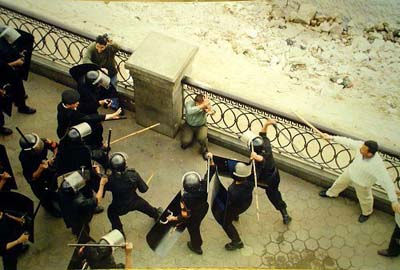 |
Meirowitz (Prof. of Politics, Princeton) & Tucker (Assoc. Prof. of Politics, NYU) look at the role of the individual & past experiences in determining whether citizens will decide to participate in protests. (i.e. why are citizens willing to bear the cost of protesting once to remove a go, only to shrug their collective shoulders at that same scenario coming to place later?) - http://ow.ly/agziQ
"However, a third conclusion from the model is a bit less obvious. Namely, we find that the one-shot deal scenario may be more likely when citizens have less certainty about the nature of the universe of potential governments. To put this more intuitively, in an established democracy, we might expect that citizens generally believe the quality of the government will be “good.” (By “good” we don’t necessarily mean that the government is above average for the governments in that country, but only that it meets some basic threshold such as competently executing government policy, not being corrupt, not stealing from the population, etc. Governments that fail to meet this threshold could be considered “bad.”) Thus in an established democracy, when by misfortune citizens happen to get the odd “bad” government, it is worth a potentially costly effort (i.e., an extended protest) to replace that government, because you are confident your replacement will probably be good.
In a new regime, however, citizens may have much less confidence about the universe of potential governments, i.e., whether in general most governments are good or most governments are bad. Consider the case of Ukraine in 2005 following the Orange Revolution. Citizens have observed a number of bad governments. This may be because (a) non-democratic governments are bad or (b) most Ukrainian politicians are corrupt. At the time of the Orange Revolution, Ukrainians may have been motivated to protest because they believed (a) to be the case, and thus switching to a more democratic system would usher in a period where governments would be generally good. However, if 2005-2010 reveals nothing more than a series of bad, democratically elected, governments in Ukraine, then Ukrainian citizens may come to believe that they are simply living in a world where all Ukrainian governments are bad. And if that’s the case, why bother protesting again?
Which brings us back to Egypt. If political developments proceed as expected, then at some point in the near future Egypt will have democratic elections. My post today should be taken as a warning that to expect the events of early 2011 to serve as a guarantee of good governance in the post-Mubarak era might be naïve. Indeed, to the extent that any post-Mubarak government fails to live up the expectations of the Egyptian citizenry, it might counter-intuitively make those citizens less likely to protest in the future. Thus the stakes for Egypt’s initial post-Mubarak governments may be even higher than we already expect."
I think this can also be expanded to describe our failure at enacting a variety of changes, not just changes in government...
Unless one fundamentally believes that people in this region (or the developing world as a whole) are inherently inferior to those in the currently democratic, developed nations then the full UNIVERSE OF POTENTIAL GOVERNMENTS"/SOLUTIONS EXISTS exists for us as well– and there is no fundamental reason we should not have access to that whole universe! I'm sick of hearing people’s ideas put down because “the West doesn’t even have that”… I don’t recall the men of the renaissance only aspiring to achieving parity with the Ottomans or Chinese, or the US founding fathers limiting themselves to what the UK had…
Fundamentally, it also comes down to stop giving ourselves excuses… when we are abroad and the streets are clean, people stand in lines, etc we think “Tab why can’t we do this?” and a myriad of problems arise: lack of education, people are lazy, etc. etc… The answer needs to be “WE CAN DO THIS” and the thinking should be on how to enact that, instead of wasting mental energy as to why it CANT be done…
Yeah, it won’t happen overnight but having the belief that we actually can reach there is the first step… It sounds cheesy but I do believe we live with this strange complex about our ability vis-à-vis that of Western nations/people..
Much of the summary provided by this excellent piece on the Wall Street Journal by one of the authors http://ow.ly/agzsf
"However, a third conclusion from the model is a bit less obvious. Namely, we find that the one-shot deal scenario may be more likely when citizens have less certainty about the nature of the universe of potential governments. To put this more intuitively, in an established democracy, we might expect that citizens generally believe the quality of the government will be “good.” (By “good” we don’t necessarily mean that the government is above average for the governments in that country, but only that it meets some basic threshold such as competently executing government policy, not being corrupt, not stealing from the population, etc. Governments that fail to meet this threshold could be considered “bad.”) Thus in an established democracy, when by misfortune citizens happen to get the odd “bad” government, it is worth a potentially costly effort (i.e., an extended protest) to replace that government, because you are confident your replacement will probably be good.
In a new regime, however, citizens may have much less confidence about the universe of potential governments, i.e., whether in general most governments are good or most governments are bad. Consider the case of Ukraine in 2005 following the Orange Revolution. Citizens have observed a number of bad governments. This may be because (a) non-democratic governments are bad or (b) most Ukrainian politicians are corrupt. At the time of the Orange Revolution, Ukrainians may have been motivated to protest because they believed (a) to be the case, and thus switching to a more democratic system would usher in a period where governments would be generally good. However, if 2005-2010 reveals nothing more than a series of bad, democratically elected, governments in Ukraine, then Ukrainian citizens may come to believe that they are simply living in a world where all Ukrainian governments are bad. And if that’s the case, why bother protesting again?
Which brings us back to Egypt. If political developments proceed as expected, then at some point in the near future Egypt will have democratic elections. My post today should be taken as a warning that to expect the events of early 2011 to serve as a guarantee of good governance in the post-Mubarak era might be naïve. Indeed, to the extent that any post-Mubarak government fails to live up the expectations of the Egyptian citizenry, it might counter-intuitively make those citizens less likely to protest in the future. Thus the stakes for Egypt’s initial post-Mubarak governments may be even higher than we already expect."
I think this can also be expanded to describe our failure at enacting a variety of changes, not just changes in government...
Unless one fundamentally believes that people in this region (or the developing world as a whole) are inherently inferior to those in the currently democratic, developed nations then the full UNIVERSE OF POTENTIAL GOVERNMENTS"/SOLUTIONS EXISTS exists for us as well– and there is no fundamental reason we should not have access to that whole universe! I'm sick of hearing people’s ideas put down because “the West doesn’t even have that”… I don’t recall the men of the renaissance only aspiring to achieving parity with the Ottomans or Chinese, or the US founding fathers limiting themselves to what the UK had…
Fundamentally, it also comes down to stop giving ourselves excuses… when we are abroad and the streets are clean, people stand in lines, etc we think “Tab why can’t we do this?” and a myriad of problems arise: lack of education, people are lazy, etc. etc… The answer needs to be “WE CAN DO THIS” and the thinking should be on how to enact that, instead of wasting mental energy as to why it CANT be done…
Yeah, it won’t happen overnight but having the belief that we actually can reach there is the first step… It sounds cheesy but I do believe we live with this strange complex about our ability vis-à-vis that of Western nations/people..
Much of the summary provided by this excellent piece on the Wall Street Journal by one of the authors http://ow.ly/agzsf

